The bluebells are early again.
Imogen Reaves · 24 April 2026 · 6 min read
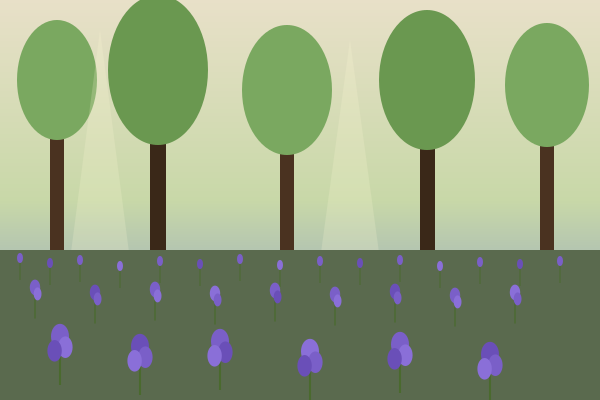
I have been counting bluebells in the same Hertfordshire wood for fourteen springs. The methodology has not changed: the same six transects, the same 1m² quadrats laid down at the same fifty paces, the same field notebook (now in its third volume).
What has changed is the calendar. In 2012, the first widespread bloom on this site fell on the 7th of May. Last week — Sunday the 19th of April — I walked into a haze of blue so dense it stopped me where I stood. We are running, on average, eleven days ahead of where we were a decade ago.
This is not, by itself, a catastrophe. Bluebells are plastic enough as a species to survive shifts of this magnitude. But they are not the only thing the woodland is timed to. The pollinators that depend on them, the migratory birds that should arrive about a week before peak bloom, the woodland soil moisture cycle — all of these are tuned to a calendar that is now slightly out of step.
What we are doing about it.
The honest answer is: not enough, and we know it. What we can do is keep counting. The transect data we gather every spring on these sites becomes part of a national dataset — coordinated through the Botanical Society — that will eventually make the scale of the shift impossible to ignore.
The other thing we are doing is choosing what to plant, and where. In our 2026 restoration plantings we have begun including a slightly higher proportion of species — small-leaved lime, wild service tree — whose southern English range is already expanding northward of its own accord. Not as replacement for the oaks and hawthorns that have always been here, but alongside them. A hedge against a future we cannot yet read clearly.
"We do the same survey, the same way, year after year. Eventually the data tells us a story we did not set out to find."
If you are walking through one of our project sites this spring, I'd ask one small thing of you. If you see a bluebell — count, just for a moment, how many other species you can spot in the same square metre. The wood anemone, the lesser celandine, the wood sorrel, the dog's mercury. Each of them is a thread. The woodland is the weave.
Imogen Reaves is the Lead Ecologist at Spring Forest UK and has overseen the East of England survey programme since 2010.